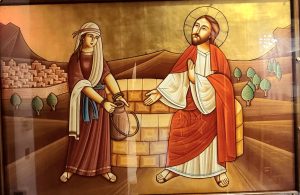
 The Church has chosen the same passage of this Gospel to be read twice: on the 4th Sunday of Great Lent and the 3rd Sunday after Pentecost. This is in order to show how the same woman, who was sinful, repented, then after her soul was converted, she can now live the resurrected life.
According to tradition, Christ Himself called her Photini (which means, “enlightened”) when she encountered Him at Jacob’s well (a symbol of the baptismal font) – just as all of us begin our life in Christ through Baptism. She was baptized by the Apostles, labored in the spread of the Gospel in various places, and finally received the crown of martyrdom in Rome.
In this icon, Christ asks St. Photini for a drink. She in return offers Him her jar which is all what she has (the earth can only offer what is earthly) so that He may offer her what is from above. The synaxis of Christ and the Samaritan woman detail the stages of Christian initiation. First, is purification in baptismal water, which is transformed into a gift of the Spirit. Second, is illumination through the recognition of the Messiah as the Son of God, for St. Photini recognizes Christ as the Messiah when He spoke about proper worship. Finally, there is the union with Christ – she becomes a witness to the Faith and confesses Christ before others.