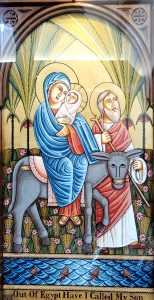
 After Herod gave the command to slay the children in Bethlehem, the just elder Joseph was warned by God in a dream to depart into Egypt (Mt. 2:13-16). According to tradition, as soon as Christ entered Egypt with his Mother and St. Joseph, all the idols fell on their faces, shattered and broke to pieces in fulfillment of Isaiah’s prophecy. When the dwellers saw this, they asked the Holy Family to leave.
They journeyed from Palestine to Dair Al-Muharraq, entering into several villages and countries in between. From there, they went through the desert of “Wadi El Natrun,” where their presence brought blessings as it became the site of more than fifty monasteries, though only four are active and inhabited today.
At “Matareya,” a fragrant balsam tree sprouted where the Virgin had thrown the water with which she washed Christ’s clothes. This plant is used as one of the ingredients for making the Holy Myron: the Sacred Oil used in Baptism and other sacraments. Then they headed southward to Old Cairo and finally to Upper Egypt where they settled at Cusae (“Qusam”), where a famous monastery for the Virgin, known as “El Muharraq” is located until this day.
In the icon, there are twenty-four plants symbolic of the 24th of Pachons (the feast day). The Ibis bird was called “the savior” by ancient Egyptians because it uprooted the worms from the fields. In similitude, our Savior came into Egypt and destroyed the pagan idols. The land of Egypt is the only one outside of Jerusalem and modern day Palestine where the Lord Jesus Christ visited and dwelt for 3 years and 6 months in total.
This feast is celebrated annually by the Coptic Orthodox Church on June 1 of the Western calendar.